
Learning Intention: Engage with others to discover their experiences and their hopes for the way forward
Engaging others is central to this kind of leadership/changemaking. It creates the space for everyone to take responsibility for the success of the organisation as a whole, not just for their own jobs or work area.
This contrasts with traditional approaches to leadership, which have focused on developing individual capability while neglecting the need for developing collective capability or embedding the development of leaders within the context of the organisation they are working in.
This leadership culture is characterised by everyone focussing on continual learning and, through this, on the improvement of the service provided to customers. This requires high levels of dialogue, debate and discussion to achieve shared understanding about quality problems and solutions.
Leaders need to ensure that people adopt a leadership mentality in their roles and take individual and collective responsibility in delivering for team members and people who use services. Achieving this requires proactive and intentional engagement, careful planning, persistent commitment, and a constant focus on distributed leadership and culture.
Appreciative Inquiry
Please work your way through this section, making notes and reflecting
At its heart, AI is about the search for the best in people, their organisations, and the strengths-filled, opportunity-rich world around them.
AI is not so much a shift in the methods and models of organisational change, but is a fundamental shift in the overall perspective taken throughout the entire change process to ‘see’ the wholeness of the human system and to ‘inquire’ into that system’s strengths, possibilities, and successes.
Introductory Video
Useful for
- Framing large scale conversations
- Identifying what people care about
- Connecting to the positive
- Involving diverse stakeholders
Resource: Appreciative Inquiry
Powerful Questions
We know that questions are more transformative than answers and are essential tools of engagement. Questions create the space for something new to emerge. However, in the busy world of task, target, fix it and sort it, answers are still valued more than questions and in the short-term often feel easier.
Answers, especially those that respond to our need for quick results, while satisfying, shut down the discussion and the future shuts down with them.
What can make us impatient with questions and hungry for answers is that in organisational life there is confusion between the process of exploring a question and ‘talking shop’. The latter has no meaning and leads to an ego-based argument, analysis, explanation and defensive behaviour. The former creates space for new thinking to emerge.
Useful for
- Preparing for conversations that you want to be different
- Identifying the ‘heart’ of what you want to inquire about
- Defining patterns of questions for events, conversations with teams or one-to-ones
Resources: Powerful Questions
Empathy Journeys
Empathy journeys are conducted to enable us as leaders and change-makers to really understand the thoughts, feelings and experiences of others. This is strongly linked to the development of excellent powerful questions and the work around levels of listening and rules of engagement.
Empathy journeys find out what is going on for people in the system, they get underneath titles and dismantle assumption through genuine inquiry and listening. These empathy journeys can take many formats from a one-to-one conversation to intensive shadowing, to graphic recording and films.
Whatever the methodology, the purpose remains the same to discover what you can’t see and feel.
Useful for
- Engagement with people who use systems or services that you are trying to change/improve/innovate
- Working with teams to understand the diversity of thinking and feeling that may not be visible
- Gathering themes and insights, illuminating blind spots, and dismantling assumptions
Resource: Deeper purpose conversations
Engaging Through Influence
As leaders, and as people, we all have the capacity and capability to influence others. We know from our work on TA that we have an impact all the time and that this can be both helpful and unhelpful. This section of the toolbox invites you to think about your Circle of Influence and Concern, your Influencing Style, and your current and desired Map of Influence.
This is ostensibly a ‘White Piece of Paper’ where you visually represent your current network of influence on a sheet of flipchart paper.
This should include information on connections that are important in your world and aspirations to show where you have influence and where you need to have more influence. It might be helpful to think about who is in your circle of influence and who is in your circle of concern.
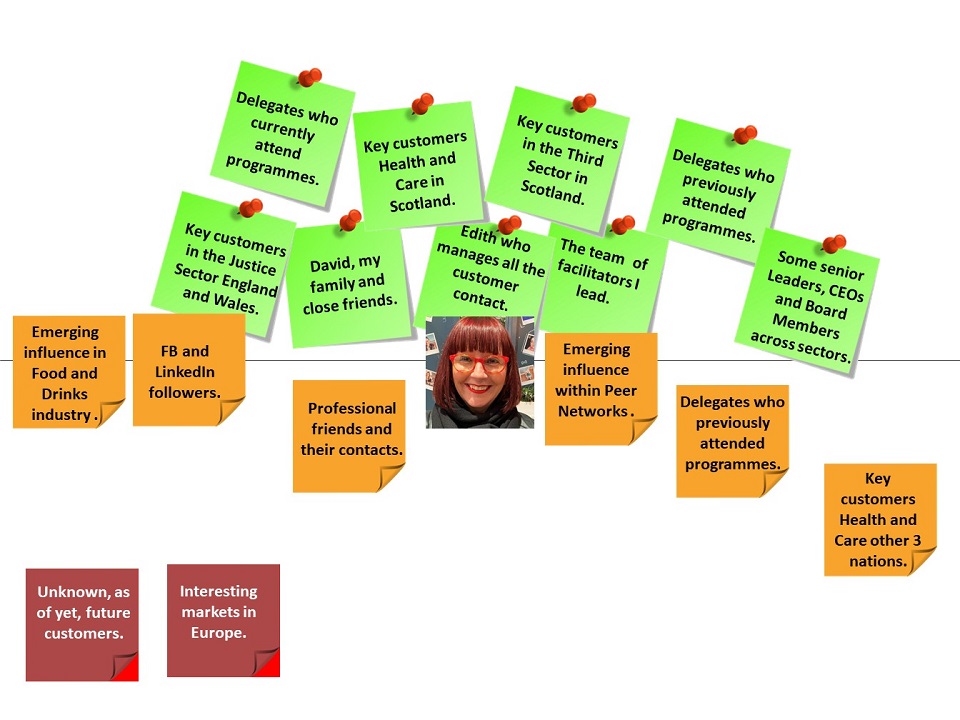
Listen to Fiona speak about her circle of influence.
Resource: Influence in the System
You will have the opportunity to create your own Map of Influence at Workshop 3.
Please bring a photo of yourself for the centre and think about who will show up where on your map.
Circle of Influence
According to Stephen Covey, proactive people focus on issues in the circle of influence, developing positive energy and confidence by making things happen and so gradually enlarging their circle of influence. In contrast, reactive people neglect the issues that are under their control and influence and grow increasingly bitter and frustrated as their circle of influence progressively shrinks.
Discover more about the Circle of Influence by watching the video below.
Sometimes in large organisations, it’s challenging to push out beyond our current circle of influence. This may require us to feel vulnerable, needing to connect to courage and confidence within ourselves. These are not the usual kinds of things that pop up on competency frameworks, especially in the public sector. However, if we as leaders need to step out and up from where we are, then it seems that these ideas matter.
Listen to Brene Brown talking about these concepts.
Useful for
- Mapping your position in the complexity of organisational life
- Seeing the patterns of where you have influence and where you need to develop your influence
- Identifying who your allies are that can reach out and support you to extend your influence
Resource: Influence in the System
Push Me Pull Me Questionnaire
Push is more about moving or forcing someone to change rather than motivating them to want to make the change. Push styles tend to involve the ‘stick and carrot’ approach. They can be effective in achieving compliance and possibly quick results but may not achieve commitment.
Pull is generally about motivating the individual to want to change and engage. They tend to involve personal disclosure, involvement and showing the possibilities that will result from change.
They tend to work on decreasing the forces or rationale against change. Pull styles can be effective in gaining commitment and high quality, but they may be slower in achieving results.
Useful for
- Identifying your preferences and patterns when it comes to how you influence people
- Connecting this information to your Transactional Analysis scores
- Reflecting on specific situations where you need to improve your influencing
Resource: Push Me Pull Me
Helpful additional information
Watch this short video about the Science of Persuasion